Rhythmanalysis in Milan: from recorded sound to module spacing
Photo Credits: Russolo, Luigi: L’arte dei rumori. Wang, Unsplash. Public Works by Cosmos. Elena Pelosi Studio
EXPERIENCE A CITY THROUGH VOICES
In brief: Milan has a pulse: trams, markets, stairwells, wind on the roofs. We record it, measure its tempo and density, and turn the numbers into rules for space, from the spacing of modules to the depth of a relief. We tested the method live during Open House Milano.
Henri Lefebvre spent his last years on a book he called Rhythmanalysis, published in 1992 after his death: a way of understanding a city through its repetitions and accelerations, the time of bodies against the time of machines. He suggested listening to a street from a window, as one listens to a body. It is the attitude we try to keep: before designing a space, we listen to how it already beats.
Listen. Cities speak in patterns: tram bells and wheel hums, market chatter, stairwell echoes, rooftop wind. We treat those everyday sounds as raw structure for spatial design.
Measure. Field recordings across Milan are segmented into time belts (dawn, midday, evening, night) and analysed for pulse, density and timbre. From these metrics, we derive spatial rules: module spacing from tempo, relief depth from amplitude envelopes, surface texture from spectral bands.
Play. The approach was tested in a live setting during Open House Milano, where a DJ mixed site-recorded voices and noises—tram strikes, street conversations, bell tones—into a performance under the theme of “Milano dall’alto.” Spectrograms and rhythm maps from that set informed subsequent material studies: incised rhythms on ceramic panels, pooled glazes following dynamic curves, and layout grids scaled to crowd-density traces.
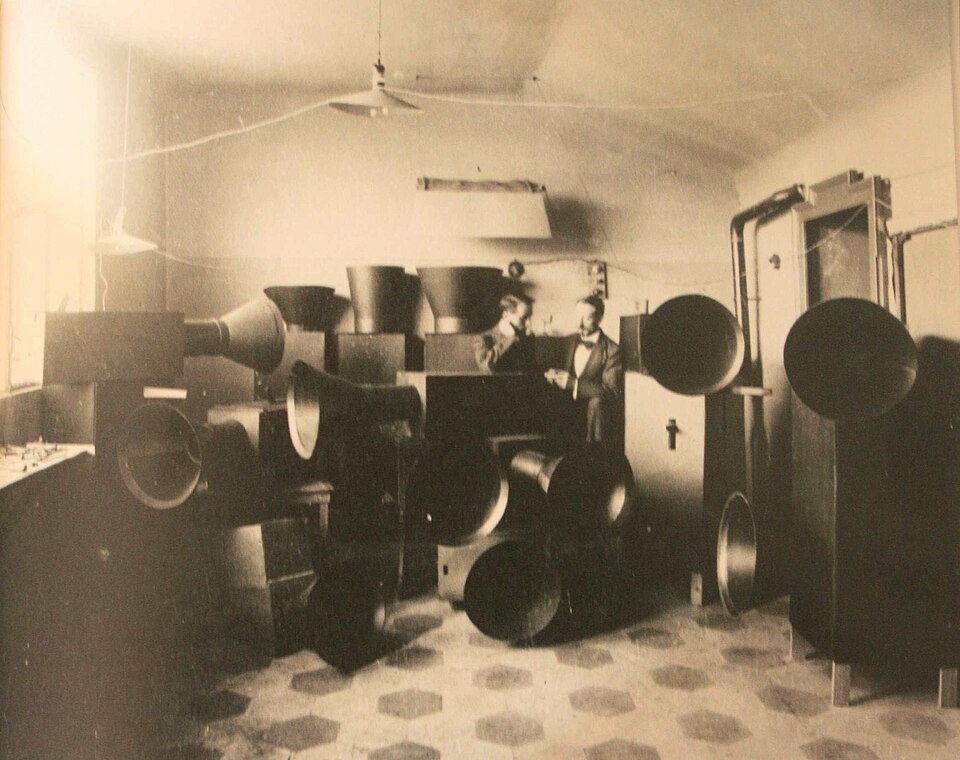
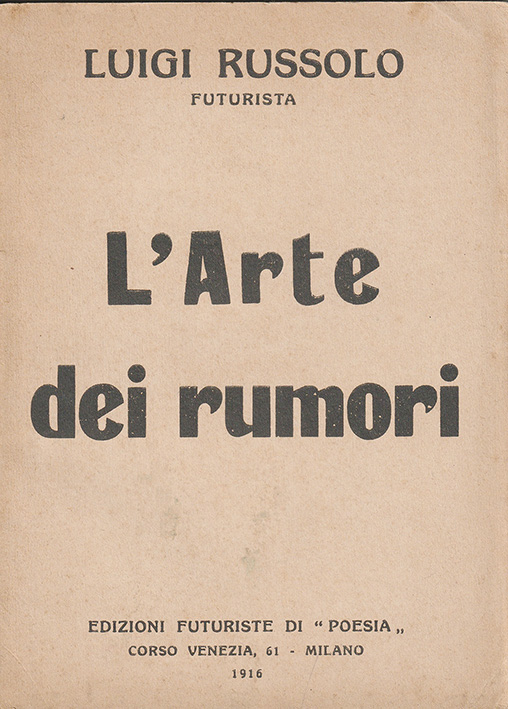
Since the 20th century, composers and designers have treated these as material: from Luigi Russolo’s L’arte dei rumori (1913) and Pierre Schaeffer’s musique concrète (1948) to soundscape ecology and sonic cartography. The Slovak composer Milan Adamčiak explored graphic scores, such as those of 1971 and 1977 held by the Nitra Gallery, turning temporal patterns into spatial arrangements on the page and, by extension, into spatialised listening when performed.
The idea is older than recorded sound. On 9 April 1860 Édouard-Léon Scott de Martinville traced a voice singing “Au clair de la lune” onto soot-blackened paper with his phonautograph, a machine that could write sound but not play it back. It was heard for the first time in 2008, when First Sounds and Lawrence Berkeley National Laboratory scanned the trace and turned it into audio. A sound kept as a drawing waited almost 150 years for its reader. The rhythms incised on our ceramic panels work the same way: a trace waiting for someone to read it.
Image: Luigi Russolo, L’arte dei rumori (The Art of Noises), 1913. Public domain.
SOURCES