How can urban rhythms be translated into spatial experiences?
EXPERIENCE A CITY THROUGH VOICES
In brief: Urban rhythms can be translated into space by recording a city’s sounds, analysing them for pulse, density and timbre, and deriving design rules from the results: module spacing from tempo, relief depth from amplitude, surface texture from spectral bands. The method was tested live in Milan during Open House Milano.
Cities speak in patterns: tram bells and wheel hums, market chatter, stairwell echoes, rooftop wind. This research treats those everyday sounds as raw structure for spatial design.
Field recordings across Milan are segmented into time belts (dawn, midday, evening, night) and analysed for pulse, density and timbre. From these metrics, we derive spatial rules: module spacing from tempo, relief depth from amplitude envelopes, surface texture from spectral bands.
The approach was tested in a live setting during Open House Milano, where a DJ mixed site-recorded voices and noises—tram strikes, street conversations, bell tones—into a performance under the theme of “Milano dall’alto.” Spectrograms and rhythm maps from that set informed subsequent material studies: incised rhythms on ceramic panels, pooled glazes following dynamic curves, and layout grids scaled to crowd-density traces.
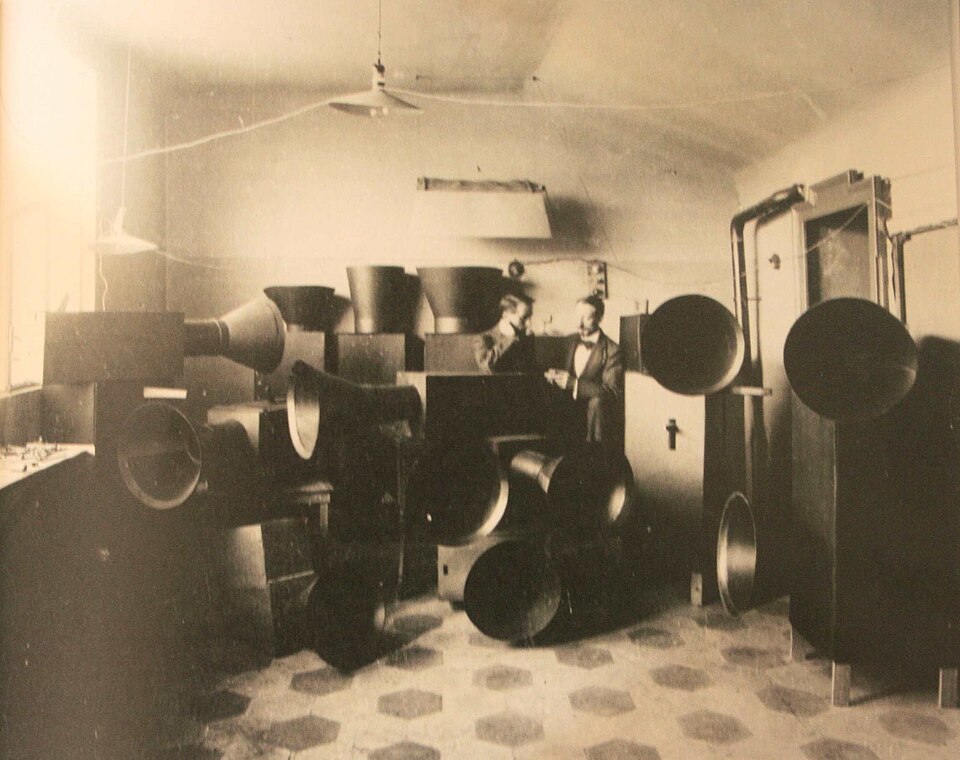
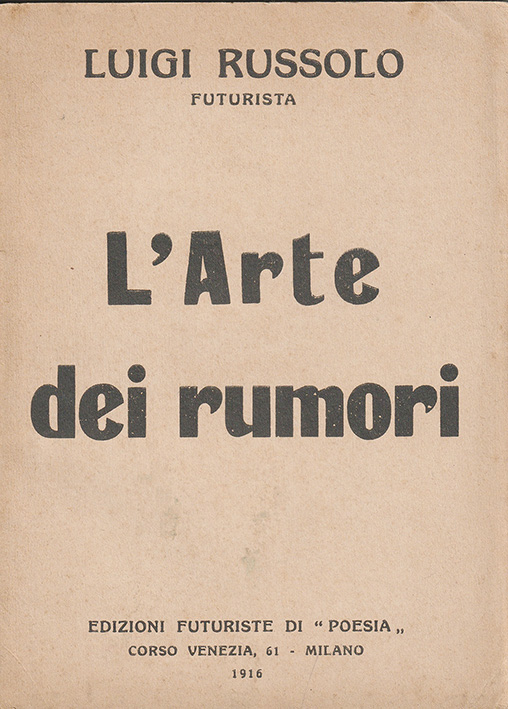
Since the 20th century, composers and designers have treated these as material: from Luigi Russolo’s L’arte dei rumori (1913) and Pierre Schaeffer’s musique concrète (1948) to soundscape ecology and sonic cartography. The Slovak composer Milan Adamčiak explored graphic scores, such as those of 1971 and 1977 held by the Nitra Gallery, turning temporal patterns into spatial arrangements on the page and, by extension, into spatialised listening when performed.
Image: Luigi Russolo, L’arte dei rumori (The Art of Noises), 1913. Public domain.
SOURCES