How can a temporary spatial threshold activate collective memory through ritual, light, and material traces?
SITE-SPECIFIC RESEARCH TO COMMUNICATE THE MEMORY OF A PLACE THROUGH ITS MATERIAL ORIGIN
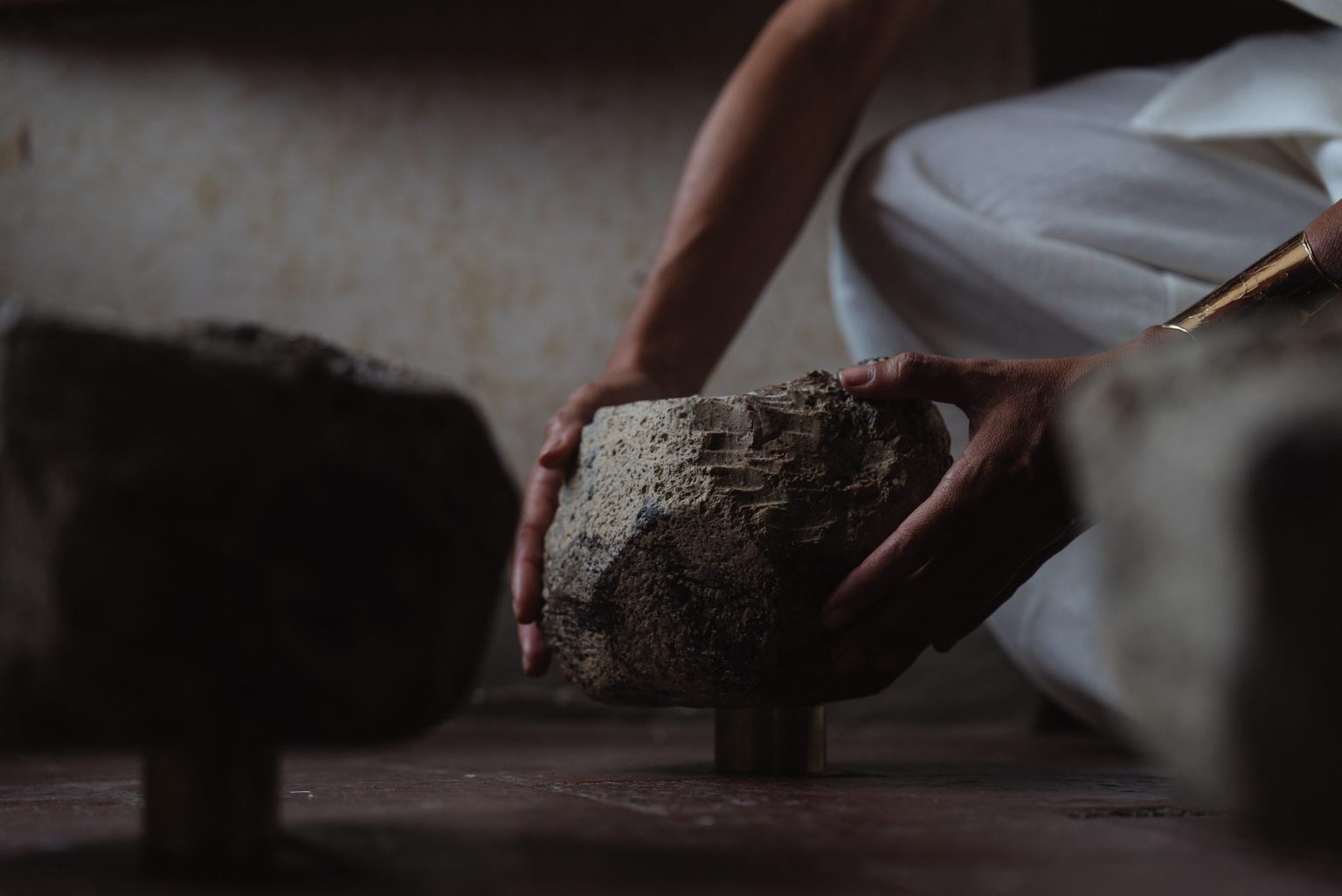
In brief: A temporary threshold can activate collective memory when it is built from the matter of a place and the forms of its heritage. With Florencia S. M. Brück, Elena Pelosi designed ceramic vessels modelled on Platonic solids documented in pre-Roman Italy, holding stones collected in Tuscany during the 2024 residency, with generative geometries mapped onto their surfaces.
This research investigates how the physical matter of a place, such as stones, soils and historical form vocabularies, can be composed into a communicative system for memory. Developed through a collaboration between Elena Pelosi and Florencia S. M. Brück, the project anchors contemporary digital practices in local material evidence.
By specifying provenance (stone origin, clay body, geometric source), the study formulates a method: derive form from local heritage, embed local matter, and use digital systems to reveal structure rather than replace it. The outcome is a site-specific protocol for communicating place-memory through material origin, with clear pathways for replication in future contexts.
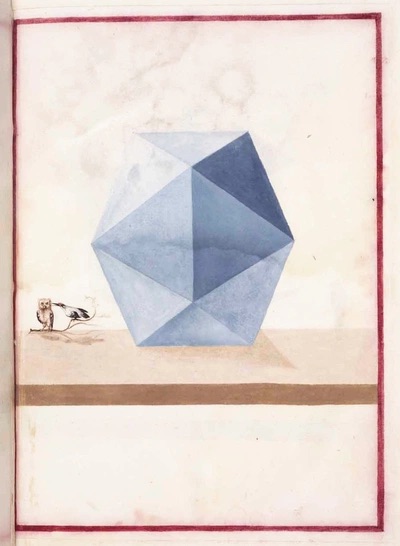
Ceramic vessels, modelled on Platonic solids documented in pre-Roman Italy (including a stone dodecahedron found on Monte Loffa, near Verona, and published by Stefano De Stefani in 1885), are designed to contain stones collected in Tuscany during the 2024 residency. This pairing locates the work in a specific geology and cultural lineage. Generative geometries, authored in code and refined with AI, are digitally mapped onto the ceramic forms, activating them as dynamic carriers of pattern and meaning. Arranged according to the Fruit of Life geometry, the installation establishes a spatial threshold where physical artefacts and algorithmic overlays co-produce an experience of time, origin and continuity.
SOURCES
- A. C. Sparavigna, An Etruscan Dodecahedron, arXiv:1205.0706 (2012), with an excerpt of De Stefani’s 1885 paper
- Stefano De Stefani, Sopra gli scavi fatti nelle antichissime capanne di pietra del Monte Loffa a Sant’Anna del Faedo, Verona, 1885